
Prop trading firms let traders access more capital through structured accounts and evaluations, using the firm’s funds instead of their own, so they don’t take on financial risk.
To get a funded account, you need to complete an evaluation or challenge, which involves hitting specific profit targets within risk limits. After passing the challenge, you can start trading with the prop firm’s capital instead of your own money.
Some trading firms also offer instant funding accounts, which skip the evaluation for a higher fee. To keep your funded account, you must follow the prop firms trading rules, like risk and drawdown limits.
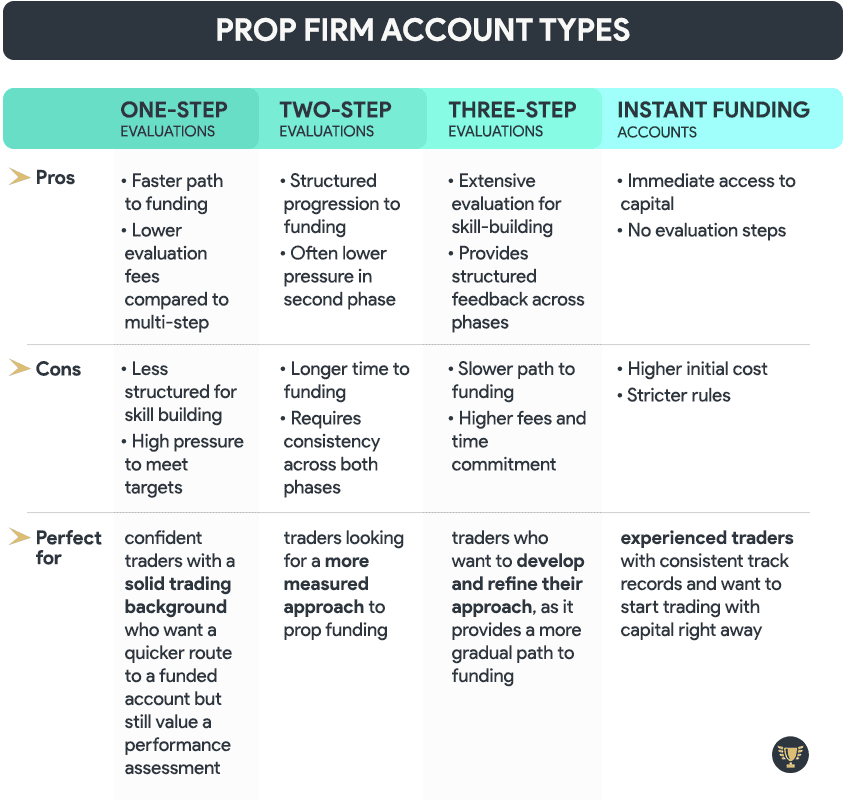
One-step evaluations are straightforward, single-phase challenges that let you demonstrate your trading skills by meeting a single profit target within defined risk limits.
Unlike multi-step evaluations, this model fast-tracks you to funding with just one successful performance check. You’ll pay a one off fee to access the challenge, and if you meet the profit and drawdown requirements, you’ll be eligible for a funded account.
One-step evaluations suit confident traders with a solid trading background who want a quicker route to a funded account but still value some level of performance assessment.
If you’re comfortable managing risk and hitting targets without needing an extensive evaluation period, a one-step challenge may be a good fit.
For beginner traders, however, it may lack the structured progression that multi-step models offer.
Pros and Cons of One-Step Evaluations
Pros
Cons
Prop Firms Offering One Step Challenges
Prop firms such as DNA Funded and FundedNext provide streamlined one-step evaluation challenges, allowing traders a quicker path to securing funded accounts.
These challenges offer a simplified evaluation process with straightforward profit targets, appealing to traders seeking fast-track funding without multi-phase evaluations.

Two-step evaluations involve a two-phase challenge to assess your trading skills and consistency. In the first phase, you’re typically asked to reach a specific profit target while adhering to drawdown limits.
If you meet these goals, you’ll progress to the second phase, where the requirements are often reduced, such as a lower profit target, allowing you to focus more on stable performance rather than aggressive growth. By completing both stages, you gain access to a funded account.
Two-step evaluations suit traders looking for a more measured approach to prop funding. They provide a balanced assessment, allowing you to show consistent performance over two phases.
This structure may appeal if you’re comfortable with evaluation but prefer a bit more structure than a single-phase model offers. Newer traders also benefit from the added structure, as the phased approach allows for gradual skill development.
Pros and Cons of Two-Step Evaluations
Pros
Cons
Prop Firms Offering Two Step Challenges
IC Funded and OANDA Prop Trader both offer two-step evaluations, ideal for traders seeking a structured pathway to a funded account.
IC Funded partners with IC Markets, providing competitive spreads from 0 pips, low entry fees starting at $49, and profit splits from 75% to 80%. OANDA Prop Trader offers accessible fees from $35, profit splits up to 90%, and the MetaTrader 5 platform.
Three-step evaluations add an extra layer of testing to assess a trader’s long-term consistency, discipline, and risk management skills.
Typically, these accounts require traders to complete three distinct phases, with each step involving a progressively refined set of goals and drawdown limits. For instance, the first phase may have a higher profit target, while subsequent stages may introduce additional rules that encourage disciplined trading.
Passing all three stages typically results in a funded account with the firm.
Three-step evaluations are ideal if you’re looking for a thorough assessment of your trading abilities or if you’re a trader who thrives under structured, progressive challenges. This model is particularly beneficial for traders who want to develop and refine their approach, as it provides a more gradual path to funding.
However, it may not be suitable if you’re aiming for faster access to capital, as the three-step process demands time and consistent effort across multiple phases.
Pros and Cons of Three-Step Evaluations
Pros
Cons
Prop Firms Offering Three Step Challenges
Only a few prop firms currently offer three-step evaluation models due to the comprehensive nature of this process. Firms like Maven Trading and The 5%ers include this option, catering to traders who prefer a more in-depth, phased approach to becoming funded.

Instant funding accounts let you skip the evaluation phase entirely, giving you immediate access to trading capital from the start.
These accounts appeal to prop traders looking for a fast pathway to trading with larger capital without meeting extensive profit targets or other benchmarks first.
The one-time fees for instant funding is typically higher than for accounts with multi-step evaluations, but the trade-off is direct access to a funded account without going through an evaluation phase.
Instant funding accounts are ideal if you’re an experienced trader with a consistent track record and you want to start trading with capital right away. This prop model works well for those who want to avoid the challenge of meeting multiple evaluation stages and are confident in their ability to manage risk from day one.
However, it may not suit if you are new to prop trading and need a structured assessment period to refine your trading strategies.
Pros and Cons of Instant Funding Accounts
Pros
Cons
Best Prop Firms for Instant Funding
Several prop firms provide instant funding options for traders who want immediate access to capital. Examples include FTP’s Masters Program offers a straightforward pathway to funded trading without an evaluation stage.

Once traders successfully complete the evaluation phases—whether through one-step, two-step, or even three-step processes—they transition to a funded account.
With a funded account, you gain access to the firm’s capital, allowing you to trade larger positions and capture opportunities you might not otherwise reach with personal funds alone.
Transitioning from an evaluation account to a funded account is often a shift in trading responsibility. You now have access to real capital, so firms typically require traders to maintain a steady performance.
Firms implement drawdown limits and require regular risk management to ensure the firm’s capital is protected. Some prop firms continue periodic evaluations to ensure traders are upholding standards, reinforcing a sense of accountability and long-term stability.
Funded accounts operate on a profit-split model, where the prop firm takes a percentage of any profits earned. Most firms offer competitive profit splits—often ranging from 70% to 90%—allowing you to keep the majority of your earnings while sharing a smaller portion with the firm.
Payment schedules vary, with some firms allowing weekly or bi-weekly withdrawals, while others operate on a monthly cycle. When choosing a funded account, check the payout conditions and make sure they align with your trading style and cash flow needs.
Many prop firms encourage successful traders by offering structured scaling plans to increase account size over time. Scaling allows you to grow your trading capital incrementally based on your consistent performance.
For example, some firms double your account balance after achieving specific profit and risk milestones over a set period. Scaling not only increases your earning potential but also provides an incentive to maintain disciplined trading practices.
Some prop firms offer standout funded trader programs that cater to various trader needs. Prop firms like DNA Funded and IC Funded are known for their generous profit splits and flexible payout structures, while FTMO and FundedNext provide scaling opportunities that reward disciplined, consistent performance.
Each trading program varies, so reviewing individual terms can help you find the best fit based on your trading goals and growth aspirations.

Many prop trading firms offer add-ons that allow you to tailor your account to better match your trading goals and preferences. These optional features enhance flexibility in areas like profit-sharing, leverage, and payout frequency, providing you with a more personalised trading experience. Add-ons are especially useful if you’re looking to maximise earnings, reduce restrictions, or access funds more quickly.
Types of Challenge Add-Ons
Add-ons vary by firm, but some common types include:

Customising accounts with add-ons allows you to adapt the prop trading experience to your specific trading needs. By selecting options like higher profit splits or reduced restrictions, you can create an environment that maximises your earning potential while providing flexibility.
This is especially beneficial if you have a specialised trading strategy that doesn’t fit within the standard account parameters.
While add-ons can offer significant advantages, they often come with additional costs, so it’s essential to weigh the benefits against the extra fees. Also, consider how each add-on aligns with your risk tolerance and trading goals.

Choosing the right prop trading challenge can make a big difference in your trading journey.
Here’s a step-by-step guide to help you assess and select a challenge that aligns with your experience, goals, and risk tolerance.