
OANDA Prop Trader ranks 8th among the top 20 prop firms we’ve reviewed with a score of 85/100. When testing the firm, we found it to be a good option for beginner traders thanks to clear rules, competitive pricing, and some of the best educational resources for prop traders via OANDA Labs.
OANDA Prop Trader now offers a single two step challenge across all account sizes, after fully retiring the old Boost model. The structure is consistent from $5K up to $500K, with the main differences appearing at the top-end account in how drawdown and consistency rules are applied.
| Feature | Two Step Challenge | Two Step Challenge |
|---|---|---|
| Account Types | 5K – 200K | 500K |
| Challenge Fees | $35 – $1,200 | $2,400 |
| Profit Share | 80% | 80% |
| Phase 1 Profit Target | 5% | 8% |
| Phase 2 Profit Target | 5% | 5% |
| Max Daily Loss | 5% Fixed (initial balance) | 5% Dynamic (previous EOD) |
| Max Total Loss | 10% – Static Drawdown | 10% – Trailing Drawdown |
| Refund of Challenge Fee | Yes, after the first profit payout | Yes, after the first profit payout |
| Who It’s For | Beginner traders | Experienced traders |
| Merging of Accounts | Yes (merging cap $200K) | No (merging cap $200K) |
| Minimum Payout Request | $200 | $200 |
This two step challenge is designed for traders who prefer clear rules and a gradual evaluation process. You must hit the same profit target in both phases while staying within fixed loss limits, before moving on to a funded Signal Provider account.

Account sizes range from $5,000 to $500,000, with entry fees starting at $35. All plans use a flat 80% profit split, and challenge fees are refunded after the first profit share payout on the most recent challenge only.

 OANDA Prop Trader uses a single two step challenge, so you’re not choosing between different models or rule sets. Both phases follow the same structure, which makes it easier to adjust your risk once and carry that approach through the entire evaluation.
If you’re trading a $5K to $200K account, the profit target is 5% in Phase 1 and 5% again in Phase 2. The $500K account is slightly tougher at the start, with an 8% target in Phase 1, followed by 5% in Phase 2. Aside from that difference, the evaluation process works the same way across all sizes.
| Account Size | Fee | Phase 1 Profit Target | Phase 2 Profit Target | Max Daily Loss | Max Total Loss | Drawdown Type |
|---|---|---|---|---|---|---|
| $5,000 | $35 | $250 | $250 | $250 | $500 | Static |
| $10,000 | $60 | $500 | $500 | $500 | $1,000 | Static |
| $50,000 | $299 | $2,500 | $2,500 | $2,500 | $5,000 | Static |
| $100,000 | $599 | $5,000 | $5,000 | $5,000 | $10,000 | Static |
| $200,000 | $1,200 | $10,000 | $10,000 | $10,000 | $20,000 | Static |
| $500,000 | $2,400 | $40,000 | $25,000 | $25,000 | $50,000 | Trailing |
Your loss limits depend on the account tier you choose. On $5K – $200K accounts, the max daily loss is a fixed 5% of the initial balance, reset each trading day, and the maximum drawdown is a static 10%. That drawdown level never moves, even if your equity increases, which keeps risk planning simple and predictable.
On the $500K account, risk is managed more dynamically. The daily loss limit is set at 5% of the previous end-of-day equity, locking in at the start of each trading day and staying fixed until the next reset. The 10% maximum drawdown trails upward as your account reaches new balance highs based on realised profits, but it stops trailing once it reaches the original starting balance. This means you need tighter control as profits build.
If you pass more than one challenge, you can merge accounts only when the settings are identical, and only up to a maximum combined allocation of $200,000. Any additional passed accounts above that limit are placed on hold until you no longer have an active allocation.
OANDA applies the same trading rules across all accounts, with only a few limits changing on the $500K plan. The rules are designed to control downside risk during the evaluation while limiting how much profit you can concentrate in a single day.
Verdict on OANDA’s Challenges and Rules
OANDA Prop Trader runs a single, clearly defined two step challenge with no add-ons or other models. Profit targets are modest, loss rules are strict but transparent, and the main complexity comes at the $500K level with trailing drawdown and higher daily profit caps. If you prefer consistency and broker-style risk controls over flexibility, this setup is easy to understand but leaves little room for customisation.
OANDA recently moved to a core pricing plus commission model for forex and metals, bringing its pricing structure in line with most professional prop trading environments. This change replaced the old spread-only setup, where all costs were built into a wider spread. Now, spreads are much tighter, but each trade includes a small, fixed commission.


For forex pairs, spreads start from 0.0 pips, which means you can often enter positions at or near the true market price. Alongside this, OANDA charges a $7 commission per standard lot traded, calculated as $3.50 each way.
Index and commodity CFDs still operate under the spread only model, so no additional commission fee is charged on those instruments.
This pricing setup is designed to make trade costs clearer and fairer. The lower spreads mean tighter execution and less slippage for short term traders, while the fixed commission ensures transparency for anyone who wants to calculate exact trading costs.
Verdict on OANDA’s Spreads and Commissions
OANDA’s pricing scored 8/10 because of their balance of tight pricing and transparent costs. Spreads on forex start from 0.0 pips and gold from 0.1, paired with a flat $7 roundturn commission per lot. The pricing is fair and consistent, though if you are moving from spread only models you might need time to adjust to the added commission.
OANDA offers three core asset classes for the prop program, focused on forex, indices, and commodities. You can access 56 financial markets in total, with 36 forex pairs, 15 indices, and 5 commodities. Unfortunately, crypto trading in not available with OANDA prop trader.
Instead, the lineup targets the most traded markets, which keeps execution tidy and pricing consistent for day traders and swing traders.


The highest leverage is 100:1 for forex and gold, while indices and the rest of the commodity suite run at 50:1. This split matters for risk planning. If you trade XAUUSD, you get the same 100:1 headroom as EURUSD, but instruments like oil, silver, and index CFDs sit at the lower 50:1 setting.
| Asset Class | Leverage Ratios | No. of Instruments | Financial Markets |
|---|---|---|---|
| Forex Pairs | 100:1 | 36 | AUDUSD, EURUSD, GBPUSD, NZDUSD, USDCAD, USDJPY, USDCHF, EURCHF, EURGBP, EURJPY, AUDCAD, AUDCHF, AUDJPY, AUDNZD, CADCHF, CADJPY, CHFJPY, EURAUD, EURCAD, EURNOK, EURSEK, EURNZD, GBPAUD, GBPCAD, GBPJPY, GBPNZD, GBPCHF, NZDCAD, NZDCHF, NZDJPY, USDNOK, USDSEK, USDCNH, USDMXN, USDZAR, USDSGD |
| Indices | 50:1 | 15 | AU200, EU50, DE40, US30, US100, US500, FR40, UK100, JP225, NL25, ES35, CH20, SG30, HK50, CN50 |
| Commodities | 100:1 on Gold, 50:1 on others | 5 | USOIL, UKOIL, NATGAS, XAUUSD (Gold), XAGUSD (Silver) |
Margin is tiered by position size, so larger tickets require more collateral. Think of it in bands rather than a single rate.
For example, on USDJPY the first 500,000 notional sits at 1% margin, the next band up to 2 million sits at 2%, then 5% for the slice between 2 and 5 million, and so on. If your total position is 1.5 million, your margin is 1% on the first 500,000 and 2% on the next 1,000,000, which totals 25,000 in required margin.
This structure rewards sensible sizing while keeping bigger exposures properly backed.
| Tier | Position Size (USD) | Margin Requirement | Example Calculation |
|---|---|---|---|
| Tier 1 | Less than $0.5 million | 1% | $500,000 position requires $5,000 margin (1% of $500,000) |
| Tier 2 | Between $0.5 million and $2 million | 2% | $1,500,000 position requires $30,000 margin (2% of $1,500,000) |
| Tier 3 | Between $2 million and $5 million | 5% | $3,000,000 position requires $150,000 margin (5% of $3,000,000) |
| Tier 4 | Between $5 million and $10 million | 10% | $7,000,000 position requires $700,000 margin (10% of $7,000,000) |
| Tier 5 | More than $10 million | 20% | $12,000,000 position requires $2,400,000 margin (20% of $12,000,000) |
Verdict on OANDA’s Markets and Leverage
OANDA received their lowest score here of 7/10. This is because while the range of trading instruments is focused and practical, its limited compared to other broker backed prop firms, and no crypto markets are available. In saying that, you get decent forex access, gold at 100:1, and the major index set, which will work well for most funded strategies.
OANDA Prop Trader only offers MetaTrader 5 (MT5), which you can access via WebTrader, desktop, and mobile. The setup is simple, stable, and familiar, and you can utilise Expert Advisors and the platforms advanced charting features.


MT5 gives you advanced charting with 21 timeframes, a solid indicator library, Depth of Market (DOM), and an inbuilt economic calendar.
Expert Advisors are supported for automated strategies, and the strategy tester handles multi-currency backtests, which helps when you need to validate systems before taking them into the challenge phases. Order management is flexible with market, limit, stop, and stop limit types, so you can script or place trades to match your style.
Execution has felt consistent in testing, helped by OANDA’s core pricing model that feeds through to MT5 tickets cleanly.
But, what’s missing is trading platform variety, there’s no MT4, no TradingView, no cTrader, and no Match-Trader. For most funded strategies this isn’t a blocker, but it does narrow your options if you rely on a specific platform’s features or social charting tools.
Verdict on OANDA’s Trading Platforms
Platforms score 8/10, due to MT5 delivering strong charting, EA support, and clean execution, which covers what funded traders need, but the lack of alternative platforms limits flexibility for those with established non MT5 platforms.
OANDA accepts challenge fees by card, Apple Pay, Google Pay, and cryptocurrency where supported. Availability varies by location, so some e-wallet and crypto routes won’t show for everyone.

When you sign up, you pay a one time fee starting from $35, and retry discounts are built in. The prop firm offers 20% off for accounts up to 50K and 10% for 100K and above.
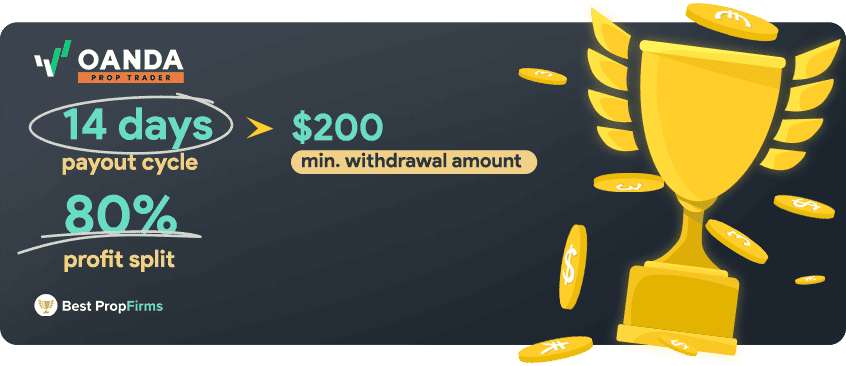
Profit payouts run on a 14 day cycle once you pass both phases and become a signal provider. Once you have a funded account, the profit split is 80%.
For withdrawals, Classic accounts have a flat $200 minimum withdrawal, and all open trades must be closed before a payout can be requested.
Funds land in your OANDA Global Markets account first, and then from there you withdraw via bank transfer, Neteller, or Skrill, or move the money to an OANDA brokerage account if you want it available for self funded trading. Challenge fees are refunded after your first successful payout, which helps offset audition costs.
Verdict on OANDA’s Deposits and Payouts
Payouts score 9/10 for being consistent, fast, and transparent. The 14-day payout cycle is reliable, the fee refund after your first payout adds real value, and traders get clear minimums that scale with account size. Combined with multiple withdrawal methods and smooth processing through OANDA’s Global Markets account, the system feels organised and easy to manage.
OANDA handles support through email, live chat, and a detailed Help Center. The Help Center does the heavy lifting, with clear articles on the challenge steps, rules, payouts, country availability, and MT5 setup, so most questions get answered without waiting on an agent. Live chat is available through the site, but availability varies by time of day, so responses aren’t always instant. Email is better for account specific issues and tends to be more consistent for follow ups.
Education sits under OANDA Labs Trader and covers the practical tools most prop traders use. You get platform guides, strategy explainers, and walkthroughs for tools like the Order Book, Position Book, and Currency Strength and Sentiment indicators. The content is focused on application rather than theory, which makes it easy to plug into your process during the challenge and once funded.
Verdict on OANDA’s Customer Service
Support is documentation first, chat second, and it works well if you start in the Help Center. The education stack is practical and easy to use, and while live chat isn’t always available, email support and the written guides keep the experience steady.
OANDA Prop Trader runs under the trusted OANDA brand, which has been in global financial markets for over 25 years. That reputation gives the prop arm an advantage in credibility, even though it operates separately from OANDA’s regulated broker branch.
The OANDA Prop Trader program is managed by OANDA Assessments Limited Company and is not regulated by authorities like the FCA, ASIC, or CFTC. This is standard for most prop firms, but traders should note that it operates independently from OANDA’s regulated CFD and forex businesses. While this means prop accounts don’t carry the same regulatory protection, the backing of a long-standing global broker adds weight to its reliability.
The program is open to traders from a wide range of countries, but not everywhere. Traders from the USA, Canada, Australia, New Zealand, Spain, Cyprus, and several sanctioned regions (including Russia, Iran, North Korea, and others) cannot join. The full list of supported countries includes over 100 locations, covering much of Asia, Africa, and South America, as well as India, Malaysia, South Africa, and the UAE.
OANDA maintains a visible presence through its Prop Trader social media channels, including Facebook, X (Twitter), and YouTube, where it posts updates, market commentary, and challenge-related content. Interaction is mainly one-way, focused on education and firm updates rather than community discussion. There’s currently no Discord or dedicated trader forum, so engagement happens mainly through social media and the Help Center.

 OANDA Prop Trader holds an average 3.7/5 star score on Trustpilot from over 400 reviews. The feedback is mixed, but a lot of traders mention the platform feels straightforward to use, with rules that are generally clear once you know where to find them. Positive reviews also highlight MT5 stability, tight pricing, and helpful support when tickets get picked up.
Where complaints come up most often is around payout and account verification timing, plus slower back-and-forth when something needs manual review. A smaller set of reviews mention frustration with rule visibility (for example, rules being easier to miss if they live in PDFs rather than the main help pages) and occasional delays getting a human response. Overall, Trustpilot sentiment points to a solid trading experience for many users, but with operational delays that can be frustrating when you are waiting on approvals or payouts.
Verdict on OANDA’s Trust and Community
Trust scores 10/10 despite the lower TrustPilot score because its one of the most well known names in the industry, and trading rules are clearing explained despite some complaints about accessibility. While the prop arm itself isn’t regulated, it benefits from OANDA’s long standing global presence and professional reputation. Combined with transparent communication, clear program structures, and helpful customer support, OANDA is one of the most dependable prop firms currently operating thanks to its broker backing.
OANDA Prop Trader sees steady global interest, pulling in around 3,600 Google searches each month and ranking as one of the more well-known broker-backed prop firms. In March 2025, Similarweb tracked roughly 90,000 site visits, putting it among the top 40 most visited prop firm websites.
Most of that traffic comes from India, the US, and the UK, with growing activity from traders in South Africa, Malaysia, and Vietnam. The mix shows that OANDA’s prop program has built a broad international reach, especially in regions where access to traditional funding is limited but retail trading communities are strong.
| Country | Q1 2025 Monthly Searches |
|---|---|
| India | 110 |
| United States | 90 |
| United Kingdom | 50 |
| South Africa | 40 |
| Malaysia | 30 |
| Germany | 30 |
| Vietnam | 30 |
| France | 20 |
| Nigeria | 20 |
| Italy | 20 |
| Canada | 20 |
| Pakistan | 20 |
| Indonesia | 20 |
| Brazil | 20 |
| Poland | 20 |
| Singapore | 20 |
| Hong Kong | 20 |
| Australia | 20 |
| Spain | 20 |
| Austria | 10 |
| Netherlands | 10 |
| Uzbekistan | 10 |
| Kenya | 10 |
| Philippines | 10 |
| Cyprus | 10 |
  India India
|
110 1st
|
  United States United States
|
90 2nd
|
  United Kingdom United Kingdom
|
50 3rd
|
  South Africa South Africa
|
40 4th
|
  Malaysia Malaysia
|
30 5th
|
  Germany Germany
|
30 6th
|
  Vietnam Vietnam
|
30 7th
|
  France France
|
20 8th
|
  Nigeria Nigeria
|
20 9th
|
  Italy Italy
|
20 10th
|
OANDA Prop Trader earned a score of 85/100 in our testing, ranking 8th overall in our shortlist of the best prop firms. The challenge has fair rules and a straightforward two step evaluation, while pricing feels competitive, with spreads from 0 pips and a $7 round-turn commission on forex and metals. Payouts are handled every 14 days, and traders get their challenge fee refunded after the first profit withdrawal, which helps offset the upfront cost.
The trading platform choice is limited to MetaTrader 5, and there’s no access to crypto markets, but execution quality and pricing make up for it. For traders who value transparency, consistent rules, and a strong brand behind their funding, OANDA Prop Trader delivers a balanced mix of structure, reliability, and value.
Yes, OANDA is a broker backed prop firm where you can access funded accounts by completing a two step challenge, where you trade a simulated account under defined risk rules with account sizes between 5K and 500K. Once you pass both steps, you move on to a funded account, aka Signal Provider, with an 80% profit split. OANDA’s prop trading branch focuses on forex, indices, and commodities, and all trading is done on MetaTrader 5.
Yes, OANDA Prop Trader is a legitimate prop trading program run under the OANDA brand, with clearly published rules and a transparent evaluation structure. They scored 85/100 during our testing, ranking much higher than prop firms like Lark Funding and Goat Funded Trader. While the prop program itself isn’t regulated in the same way as OANDA’s brokerage services, it operates with clear challenge rules and a documented profit payout process. This makes it a credible option if you’re looking for a structured, broker backed style prop challenge.
Yes, OANDA offers CFD and forex trading but the exact markets depend on where you’re located. We have a sister website (compareforexbrokers.com) that includes the following:
Yes, in the UK only OANDA offers spread betting with tax-free benefits. This niche product available for residents in the United Kingdom has a full evaluation on Spread-Bet.co.uk which can be viewed on the OANDA Spread Betting Review page.
At Best Prop FIrms, we help traders find the best prop trading firms by comparing platform features, costs, and execution speeds. Our methodology evaluates firms based on categories like profit payouts, account costs, leverage, and funding steps.
Our team rigorously tests and reviews trading tools and platforms, ensuring accurate comparisons. Key factors like spreads, account types, payments, and customer support are carefully analyzed to give traders the insights they need. We also assess trading platforms, financial markets, and community trust, providing a comprehensive resource for choosing the right prop firm.