
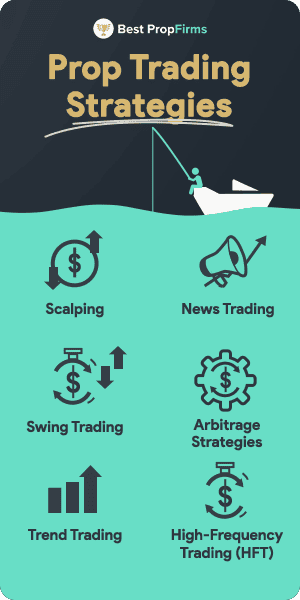
 The playbook for success in proprietary trading is wide-ranging. There is no one-size-fits-all here, and depending on the prop trader’s trading style, comfort with risk, and experience, there are plenty of strategies to choose from. Let’s look at some of the popular prop trading strategies most proprietary traders rely on to succeed.
For traders who thrive and prefer constant market action and lightning-fast moves, scalping might be their best trading approach. In a matter of minutes or even seconds, it is crucial for them to capture short-term price movements, employing technical analysis and real-time market data.
Scalpers perform best in busy markets like forex and crypto, getting in and out and booking small but steady profits. Making lots of trades very quickly entails lots of risks, making a solid risk management system paramount, to ensure that every trade is within the prop firms’ trading rules.
For traders who also want a fast-paced trading strategy but can’t keep up with a scalping strategy, swing trading might be the right style. Swing traders try to capture broader market trends, holding positions for a few days or weeks instead of chasing many quick profits.
Complementing technical analysis with some fundamental analysis, swing traders try to spot steady trends and ride the upward or downward move. Swing trading gives traders more time to think and strategize their trading decisions, unlike the high-pressure situation for scalpers.
This strategy focuses on finding the current market direction, and trying to ride the market move. Trend traders use technical analysis tools like moving averages to identify ideal entry and exit points, adjusting the trading plan as the trading climate changes.
Patience is required for this strategy, as market trends usually play out in longer time frames, unlike both swing and scalping trading strategies. While generally safer, management of risk remains essential here, as the market will not move in one direction forever.
A news trading strategy is the perfect game plan for traders who are always on top of global macro trading situation. News traders try to anticipate economic data results, especially from central bank interest rate decisions and with equities markets, company news developments all move market prices.
Market sentiment can go in one direction for a long time before suddenly swinging hard on the latest economic drop, creating volatility on which news traders can capitalize. While potentially rewarding, trading headlines can also be hazardous, as short-term price movements can be wildly extreme and unpredictable.
Just note that not all proprietary trading firms allow traders to trade the news due to the market volatility that commonly follows important market events. For traders interested in using this strategy, ensure that the trading firm allows news trading.
While markets are mostly efficient, prop traders using the arbitrage trading strategy are always on the lookout for tiny mispricing in different markets and financial instruments, locking in profits made from the price difference. This trading scheme is popular among experienced proprietary traders who can spot and exploit market inefficiencies. Some of the popular arbitrage strategies include:
For advanced traders who emphasize speed, and have access to cutting-edge algorithms, a high-frequency trading strategy is worth looking at. HFT prop traders use advanced trading systems and sophisticated code to detect and take advantage of even the tiniest small price movements, with trades being made in fractions of a second.
Requiring minimal network latency and the hefty investment in trading hardware is required for this strategy. This means that only larger financial institutions and hedge funds have access and the resources to employ this strategy. Still, there is no stopping dedicated prop traders with the required coding skills from using this strategy and taking advantage of market inefficiencies before anyone else sees them.
These are just some of the trading strategies available for proprietary traders. Depending on a trader’s personal preference, be it riding longer market moves, profiting on quick trades or finding pricing differences, the best prop trading strategies are the ones that perfectly align the trading with the trading firm’s risk parameters and the trader’s personal style.
Finding the right strategy is usually about finding the approach that feels the most natural. Whatever the trader’s preference is, it is crucial to pick the path that matches the trader’s overall trading style and the risk tolerance levels put forth by the prop trading firm. As more financial institutions engage in proprietary trading, finding the right prop trading firm is also equally important.

Proprietary traders also need to pay attention to the prevailing market conditions. In times of market lulls, employing a more deliberate strategy might help traders get in sync with the market rhythm. During choppier times, shift to a plan that can handle a more volatile market environment. Keeping in touch with the market signals will make better trading decisions, translating to more profitable trades.
But before committing to any approach, traders should not forget to test drive the trading strategies. Whether looking at new market strategies or adjusting old favorites, using demo accounts can be a great way to test new ideas.
This can help traders find the proprietary trading strategy they are most comfortable with, and gain the competitive edge before committing with their own money, and eventually trading the firm’s capital.
Prop trading firms all have their own trading playbook and rules. These rules will dictate what trading strategies traders are allowed to run, how to manage risk, and even the sort of trading tools that can be used in the firm’s trading activities.

Remember that these guidelines are set to ensure prop traders trade responsibly, knowing that traders are not using their own funds, so playing by the rules is a must to enjoy all the perks, and ultimately generate profits.
Certain market tactics like high-frequency trading, news trading, or even complex plays like volatility arbitrage involve considerable amounts of risk. As a result, many trading firms limit, or at best, require special approval before traders can employ these tactics. While traders may be keen to use these popular proprietary trading strategies, it is common for trading firms to regulate these speculative investments, preparing extra hurdles for prop traders to clear to make sure that they know what they are doing.
Some firms engage in these riskier strategies, but only after interested prop traders pay an extra fee. This is how proprietary trading firms engage with their traders, unlocking more advanced but riskier strategies. Of course, prop traders need to know the risks involved with these strategies and ensure these ideas align with their overall trading plan, not just avail these tactics just because they are available.
Prop trading firms set boundaries to keep things under control in order to protect their own capital. These guidelines include drawdown limits, position sizing limits, trading day limits, and which financial markets are allowed. Even hedge funds have their guard rails to prevent reckless moves that endanger the firm’s trading operations. These protocols are put in place not only to avoid any market surprises, but also to help traders seek a consistent method to grow their own accounts.
Having the right tools when engaging in proprietary trading can make a big difference with trading results.
Prop traders usually rely on a mix of technical analysis, complemented by fundamental research to spot trading opportunities, market entry and exit points, while staying inside the prop firm’s risk tolerance levels.
 Focuses on reading charts, looking for chart area patterns and popular technical indicators like RSI or MACD. Skilled traders in technical analysis can use these techniques to gauge short-term price movements and track market sentiments based on chart action.
These charting tools can help traders and even large hedge funds craft trading plans on how and when to jump in and out of trades. With up-to-date market data, technical analysis can help traders navigate real-time market fluctuations, leading to profitable trades.
 On the flip side, the fundamental analysis goes deeper into what news is moving the markets, earnings reports, and the global macro trading situation. While generally requiring more work compared to technical analysis, digging deep into corporate balance sheets, analysing central bank announcements, and keeping updated on the global events happening around, this technique can help prop traders understand why the markets are moving the way it is, be it on an upward or downward move.
While already effective individually, combining both technical and fundamental analysis can help proprietary traders get a leg up and develop a more inclusive trading plan. A two-pronged approach can help traders react faster to market-moving financial news, adjust market moves on the fly, and seize the opportune moment to deploy the firm’s capital to amplify the profits made.
As traders gain experience and refine their trading strategies, they will develop consistency in their ability to make profits, and establish a genuine competitive advantage against other traders.
 While racking up profits and getting a share of the winnings is the ultimate goal in proprietary trading, managing downside risks is equally important for long-term success. As they say, an effective risk management system often separates successful prop traders from those still feeling their way in the markets.
Setting up personal and individual risk tolerance is ideal. Oftentimes, prop trading firms already have these systems in place. Violations of their risk protocols will either fail the challenge, or cancel the funded trading account of the prop trader.
Diversifying across several asset classes like forex, commodities, and indices is a good idea. Spreading out the exposure on different financial instruments puts the trader in a position to not get burned by a single unforeseen market event. Spreading exposure can also open opportunities, such as arbitrage trading, when fleeting market inefficiencies occur.
Even if proprietary traders are already using the best prop trading strategies, putting all chips in one place can lead to account-ending losses. It is prudent to minimize overbetting on a single position. A single trade gone wrong on a massive position can mean the end of the funded account, wasting the effort put into the account.
After all, the whole point of proprietary trading is to use the firm’s capital effectively, aiming for small but consistent profitable trades, while keeping losses to a minimum. A trading style blended with a sound risk management plan can make traders better equipped to withstand whatever surprise the markets throw at them.
 The market setting constantly changes, especially in proprietary trading. Being in sync with the market’s move can make a huge difference in how traders perform.
One week, a position trading strategy is perfect for a stable market flow, and the following week, a global macro trading event will have their trade strategies telling them to sell securities. Seasoned prop traders know that being flexible is the key to making profitable trades, no matter the market situation.
Keeping in touch with the prevailing market trends allows traders to be always prepared to react as the markets dictate. At the same time, they tweak and adjust their trading plans on constantly evolving market conditions.
Through time and experience, skilled traders can develop and choose the best prop trading strategy as the market scenarios play out in real-time.
Knowing when to adapt and when to stay still are skills traders will develop through experience, as they go deeper into proprietary trading, and gain the competitive advantage to stand above the rest.
Serious perks await proprietary traders who manage to get a grip on the financial markets and develop a sound trading system, be it about spread trading, swing trading, and at the same time, prepared for any black swan event.

Another boon in developing and mastering the right proprietary trading strategies for each trader is the ability to spot and identify trends as they happen. Over time, traders will master various market tactics suitable for diverse market scenarios.
By developing the confidence and experience that comes naturally with success, traders can slowly transition into their skill sets and use more complex techniques like high-frequency trading and arbitrage trading systems.
Mastery of diverse trading techniques will allow for more access to advanced platforms, and use of the firm’s capital to trade, as the trader moves up the ranks of the proprietary trading firm. Without risking their capital, traders can ultimately get a bigger share of the trading gains as they get more comfortable with the strategy, allowing them to scale up their trading efforts effectively.